Good fit if…
You want to live on or near a lake full-time while keeping a normal commute, a normal school run, and normal errands — a primary home first, with the dock as a daily bonus rather than a weekend project.
 Carter Barstad
REALTOR®
A Lake Guide · Chippewa County · 79 Quiet Acres · Ten Minutes To Either Downtown · Full-Time Lake Living
Lake life without the drive.
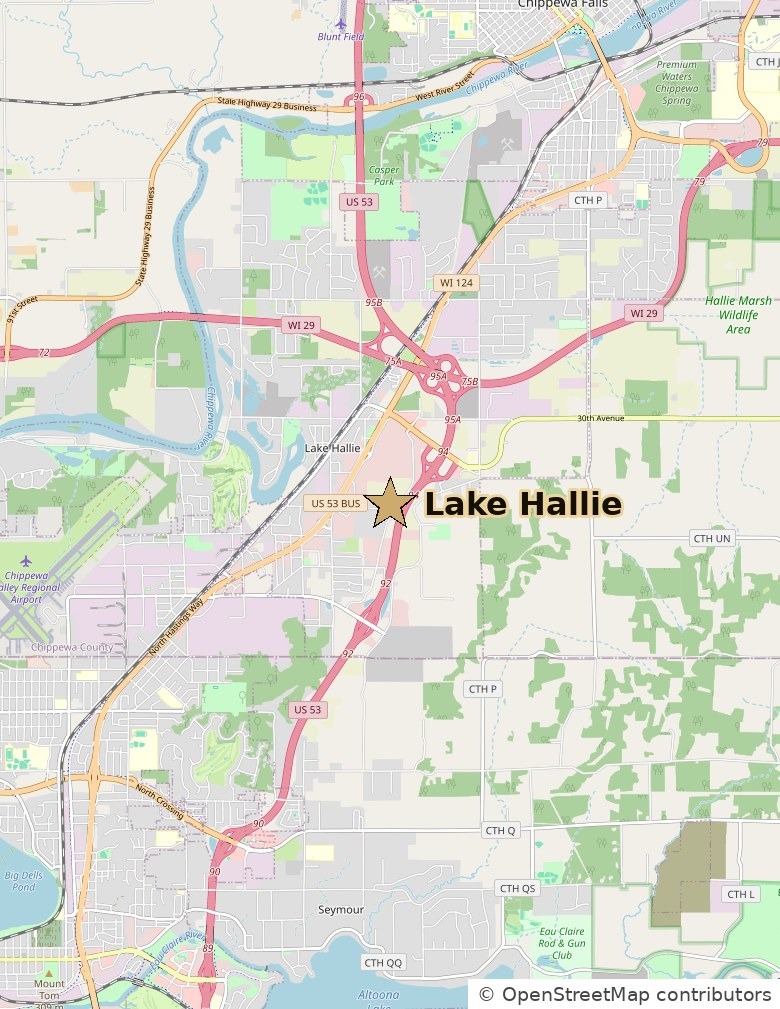
Lake and village facts: Village of Lake Hallie and the Islands profile (sources on the closing page).
“Lake Hallie is Chippewa Falls’ little brother — with great residential options of its own and both Chippewa and Eau Claire right down the road.”
Carter Barstad · Hometown Realty Group
The lake's history is pure Chippewa Valley: the Blue Mill, built here in 1843, later became Badger Mills before logging faded in the 1890s. The village around it is much newer — Lake Hallie incorporated from part of the Town of Hallie on February 18, 2003, and the 2020 census counted 7,170 residents. The Chippewa River runs along the village's west side, farmland opens to the east, and the Chippewa Valley Regional Airport is only a few minutes away.
That geography shapes everyday life here. The river side of the village feels different from the farmland side, and both sit close to the things residents use most — groceries, health care, and the downtowns in either direction. It is a young village wrapped around an old lake, and that is the honest summary: the neighborhood is still growing into itself, while the water at its center has been part of Chippewa Valley life since the logging era. For a buyer, that means judging each street on its own terms rather than assuming the whole village feels the same.
Around the lake you will find year-round single-family homes rather than rows of seasonal cabins — this is a neighborhood that happens to sit on water. The wider village mixes established streets near the lake and river with newer subdivisions that have grown as Eau Claire and Chippewa Falls have grown. True waterfront lots are limited by the lake's size, so they turn over less often than homes a street or two back — which can be the value play: lake access and the lake feel without the frontage premium.
That mix is worth touring in pairs. See one home on the water and one a street or two back on the same trip, and the difference stops being abstract: you can feel what the frontage adds — the dock, the view, the quiet at the end of the day — and what the street-back home gives you instead, which is often the same lake access and the same neighborhood for less. Carter’s advice is to price that premium on purpose, not by accident, because on a lake this size the right lot can take patience to find.
Most Lake Hallie addresses are served by the Chippewa Falls Area Unified School District, and the village is on the metro's service grid — groceries, health care in Eau Claire and Chippewa Falls, and city-style amenities are all short drives. Confirm the school assignment and whether a specific home is on municipal water and sewer or well and septic before you buy.
You want to live on or near a lake full-time while keeping a normal commute, a normal school run, and normal errands — a primary home first, with the dock as a daily bonus rather than a weekend project.
You want big-water boating. At 79 acres and 13 feet deep, this is a paddling, fishing, and pontoon lake, not a waterski lake — and waterfront inventory is small, so finding the right lot can take patience.
Drive the lake loop, then compare one waterfront home and one just off the water so you can see exactly what the frontage premium buys here. Carter can tell you which streets see listings first.
Want this guide as a PDF? The full Lake Hallie guide — the same content, printable — is free. No form, no email required; it just opens.
Download the full Lake Hallie guide (PDF)Sources: Village of Lake Hallie, Wisconsin — Wikipedia · Islands — “Wisconsin's Midwest Lake Community” profile · Chippewa County Treasurer — Chippewa County Mill Rates, 2025 Tax Roll. This guide is a starting point, not a statement about every property. Verify schools, taxes, zoning, shoreline rules, water and septic systems, rental rules, and other priorities for a specific address before you buy.
House-hunting this week? See this week’s open houses in Eau Claire — every brokerage’s open houses, in one place, no sign-up needed.
CARTER’S SALES HERE
Guides are opinions; closings are proof. 1 of Carter’s 55 career sales is in Lake Hallie — $464,900 in closed volume from the MLS-verified record behind the numbers on the home page. Most recent first:
| Street | Sold price | Sold date |
|---|---|---|
| 3939 113th | $464,900 | May 20, 2024 |
The short version: About $347 a month on a $250,000 home — the village layer is what separates this bill from the township rates in the same school district all around it.
Here is the number to plan around. For the Village of Lake Hallie, Chippewa County's 2025 tax roll puts the net mill rate at $16.63 per $1,000 of assessed value (0.016626391) for homes in the Chippewa Falls Area Unified School District, which covers most village addresses. A mill is $1 of tax per $1,000 of value. The tax is figured on the assessor's value, which is supposed to track market value but can sit above or below what a home actually sells for — and here that gap matters: the county put Lake Hallie's assessment ratio at 63.04 for this roll, meaning assessed values in the village have been running well behind market values. A revaluation can change that picture, so check the assessment on the specific home, not just the rate.
That rate is a bundle. The county treasurer publishes it as a combined net rate, not a split, and it is built from these levies:
The biggest driver is the village levy itself, and the same county sheet proves it: a home in the Town of Lafayette, in this identical school district, is taxed at $9.76 per $1,000, and a City of Chippewa Falls home at $13.70. Lake Hallie's $16.63 is the highest of the three — you are paying village-service prices on top of the same schools and county.
The worked example, on a $250,000 home. Step 1: treat $250,000 as the home's assessed value — that is the assumption in this example, stated out loud, and given that 63.04 ratio it is a deliberately conservative one. Step 2: $250,000 ÷ 1,000 = 250, and 250 × $16.63 = about $4,160 a year. Step 3: $4,160 ÷ 12 = about $347 a month.
That is the gross figure, and the real check is smaller. Wisconsin's lottery and gaming credit — $155.38 for this school district on this roll, for a primary residence — and the first dollar credit are subtracted after the bill is calculated. Special charges and assessments are not in the rate, and — as this guide already flags — whether a given street is on municipal water and sewer or on well and septic varies, which can add its own charges. Your home's actual assessment may also differ from this example price.
Why here versus the next community? Lake Hallie gives you a live-here lake and a ten-minute commute, and the tax bill is where part of that convenience shows up. Put the $347 a month in the full equation — mortgage, plus taxes, plus insurance — when you compare a Lake Hallie home against a similar one in a surrounding town.
See how all 28 areas compare: Chippewa Valley property taxes, side by side.
Yes — that is the point of this lake. Around the water you will find year-round single-family homes rather than rows of seasonal cabins, so it works as a primary home first, with the dock as a daily bonus. The wider village mixes established streets near the lake and river with newer subdivisions, and groceries, health care, and city-style amenities in Eau Claire and Chippewa Falls are all short drives.
Lake Hallie is 79 acres and about 13 feet deep — an oxbow off the Chippewa River. Its size keeps speeds and wakes low, so it suits paddling, pontoon time, and fishing for largemouth bass, northern pike, and bluegill and panfish. If you want big-water boating or waterskiing, this is not that lake; the trade is calm, quiet water close to home.
Roughly ten minutes to either downtown. The village sits on Highway 53 between the two cities, with the Chippewa River along its west side — Irvine Park and Chippewa Falls to the north, and Eau Claire’s farmers market and riverfront trails to the south. The Chippewa Valley Regional Airport is only a few minutes away, too.
Most Lake Hallie addresses are served by the Chippewa Falls Area Unified School District. School assignments are address-specific, though, so confirm the assignment for the home you are buying before you buy — and confirm at the same time whether that home is on municipal water and sewer or on well and septic, because that also varies by street.
Start at the dock: sound the water depth and check the bottom, because frontage quality varies a lot from lot to lot on a shallow lake. Then inspect the shoreline for erosion and any work already done, ask about flood history on low lots near the Chippewa River side of the village, and visit on a summer weekend to feel the parking and traffic on a street that is lived in year-round.
Yes. One of Carter’s 55 career sales is in Lake Hallie — 3939 113th sold for $464,900 on May 20, 2024. Guides are opinions; closings are proof, and Carter can pull recent sold comps for any street in this guide and line up showings so you can compare in person.
About $347 a month on a $250,000 home. The village’s net rate is $16.63 per $1,000 of assessed value on the 2025 levy — the village layer is what separates this bill from the township rates in the same school district all around it. The Taxes & total cost section above breaks the whole bill down.
Call or text (715) 828-0039, or email Carter@echtrg.com — Carter can pull recent sold comps for any street in this guide and line up showings so you can compare in person.