Good fit if…
You want the flowage style of lake life — wooded, fishing-first, a little wilder — at Chippewa Valley prices, with two of Carter’s home territories (the Valley and Ladysmith) both within easy reach.
 Carter Barstad
REALTOR®
An Expanded Lake Guide · Chippewa–Rusk Line · 2,881 Acres · Nine Landings · Musky & Walleye Flowage
Where the northwoods starts.
Lake facts: Wisconsin DNR Lake Holcombe pages; Chippewa County fishing guide.
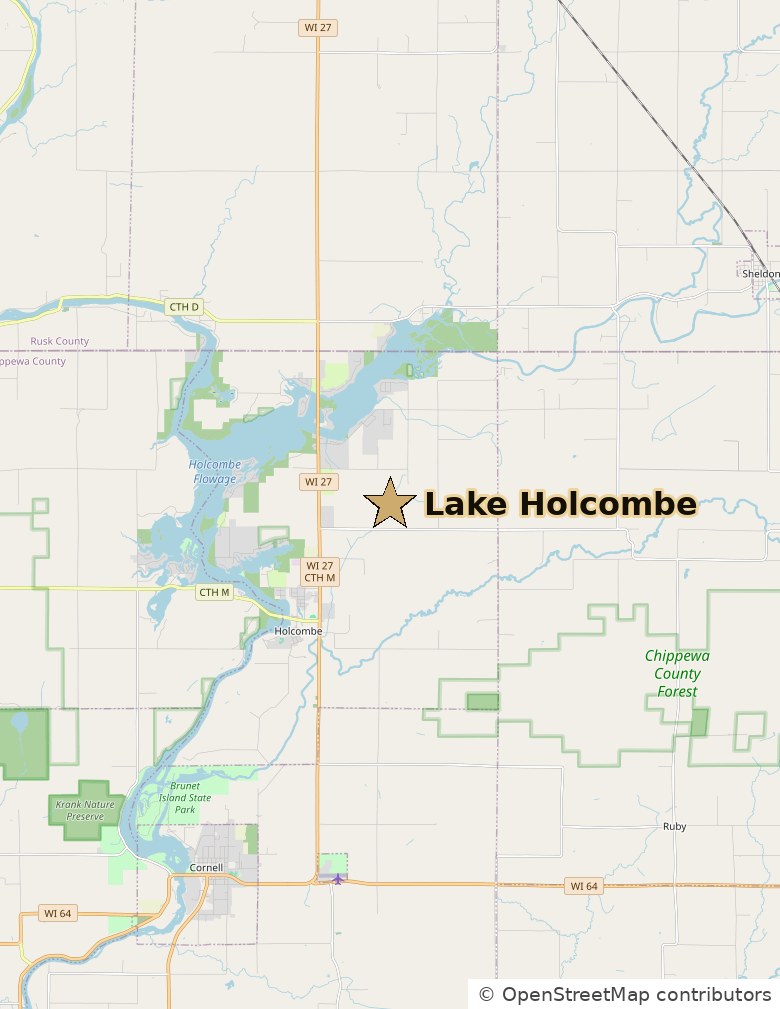
Lake Holcombe — the Holcombe Flowage — is where the Chippewa River slows down and the northwoods starts. Chippewa County’s own fishing guide calls out its strong musky and walleye populations — and its “up north,” uncrowded feel despite the popularity.
The flowage has deep logging roots. The original Little Falls Dam was built here in 1878 to hold water for floating logs down the Chippewa; the current Holcombe Dam, a hydroelectric plant built in 1950 and now operated by Xcel Energy, produces about 34 megawatts. The flowage wraps around the community of Holcombe on the Highway 27 corridor, about an hour northeast of Eau Claire and a short drive southwest of Ladysmith. Pine Point County Park gives campers and day users a base on the water. Cornell is just downriver — this is the gateway water between the Chippewa Valley and Carter’s Ladysmith country.
Classic flowage stock: seasonal cabins converted over the years, family lake homes, and resort properties — Flater’s Resort has operated here since 1938 — mixed along wooded shoreline. Because the Chippewa and the Jump River both feed the flowage, properties range from main-water points to quiet river-arm places where the dock sits in current-free backwater. Off-water acreage around Holcombe and Lake Holcombe village offers the land-and-woods version of the same lifestyle.
Addresses around the flowage sit mainly in the Lake Holcombe School District, with edges in neighboring districts — confirm for a specific property. Homes run on well and septic, and Cornell, Chippewa Falls, and Ladysmith divide the hospital and big-errand runs.
You want the flowage style of lake life — wooded, fishing-first, a little wilder — at Chippewa Valley prices, with two of Carter’s home territories (the Valley and Ladysmith) both within easy reach.
Think like a flowage buyer: stumps and floating debris after high water, marked channels to learn, and managed water levels. It rewards owners who learn the water — and punishes guessing.
Tour one main-water point and one quiet river-arm place back-to-back — the flowage’s two personalities in a single trip. Carter can flag the channel, stump, and septic questions for each listing.
Want this guide as a PDF? The full Lake Holcombe guide — the same content, printable — is free. No form, no email required; it just opens.
Download the full Lake Holcombe guide (PDF)Sources: Wisconsin DNR — Lake Holcombe facts & figures · Chippewa County fishing guide · Chippewa County Treasurer — Chippewa County Mill Rates, 2025 Tax Roll (Town of Lake Holcombe) · Rusk County — 2025 Net Mill Rates (Town of Willard). This guide is a starting point, not a statement about every property. Verify schools, taxes, zoning, shoreline rules, water and septic systems, rental rules, and other priorities for a specific address before you buy.
House-hunting this week? See this week’s open houses in Eau Claire — every brokerage’s open houses, in one place, no sign-up needed.
Guides are opinions; closings are proof. One of Carter’s 55 career closings sits in Holcombe, the flowage’s own community — from his MLS Agent Production & Inventory Report (the same record behind the numbers on the home page):
| Street | Sold price | Sold date |
|---|---|---|
| 27405 276th | $579,800 | Dec 14, 2022 |
The short version: About $193 a month on a $250,000 home on the Chippewa County side — among the lightest bills in this whole guide set — but which county your shore sits in matters, because the Rusk County side pays more.
This flowage straddles a county line, so say it plainly: there is no one Lake Holcombe rate. Most of the reservoir lies in Chippewa County, in the Towns of Lake Holcombe and Birch Creek, and a small part extends north into the Town of Willard in Rusk County. Rates vary by town and county around the lake. This example uses the primary town — the Town of Lake Holcombe, Chippewa County, in the Lake Holcombe School District — where Chippewa County's 2025 tax roll puts the net mill rate at $9.25 per $1,000 of assessed value (0.009252111). A mill is $1 of tax per $1,000 of value, and the tax is figured on the assessor's value, which is supposed to track market value but can sit above or below what a home actually sells for. The county put this town's assessment ratio at 78.06 for this roll.
That rate is a bundle. The county treasurer publishes it as a combined net rate, not a split, and it is built from these levies:
The biggest driver of the difference around this lake is which county and town the home sits in. Rusk County's own 2025 net mill rate sheet puts a Town of Willard home in this same Lake Holcombe School District at $12.71 per $1,000 — about $3.46 more per $1,000 than the Chippewa County town rate above, for the same schools and the same water.
The worked example, on a $250,000 home. Step 1: treat $250,000 as the home's assessed value — that is the assumption in this example, stated out loud. Step 2: $250,000 ÷ 1,000 = 250, and 250 × $9.25 = about $2,310 a year. Step 3: $2,310 ÷ 12 = about $193 a month.
That is the gross figure, and the real check is smaller. Wisconsin's lottery and gaming credit — $123.18 for this school district on this roll, for a primary residence — and the first dollar credit are subtracted after the bill is calculated. Special charges and assessments are not in the rate, and homes here run on well and septic, as this guide notes. Your home's actual assessment may differ from this example price.
Why here versus the next community? A township rate, a small school district, and no municipal layer keep the Chippewa County side of this flowage among the lighter bills in this guide set — one more reason the northwoods feel here comes at Chippewa Valley prices. Put the $193 a month in the full equation — mortgage, plus taxes, plus insurance — and confirm the town and county on the specific property, because on this lake that line on the map is worth real money.
See how all 28 areas compare: Chippewa Valley property taxes, side by side.
2,881 acres on the Chippewa–Rusk county line, 62 feet deep at its maximum, with nine public boat landings spread around a big, wooded flowage. Source: Wisconsin DNR.
The DNR fish list runs musky, panfish, largemouth and smallmouth bass, northern pike, walleye, sturgeon, and catfish — and Chippewa County’s own fishing guide calls out the flowage’s strong musky and walleye populations, with elbow room: nine landings spread the pressure around.
Addresses around the flowage sit mainly in the Lake Holcombe School District, with edges in neighboring districts — confirm for a specific property before you buy. Homes run on well and septic.
Lake Holcombe is a managed flowage. The original Little Falls Dam was built here in 1878 to hold water for floating logs down the Chippewa; the current Holcombe Dam, a hydroelectric plant built in 1950 and now operated by Xcel Energy, produces about 34 megawatts. Ask what the water-level pattern does to your dock in a dry year.
The marked channels. Flowages have stumps and floating debris after high water, and current and depth differ between the main flowage, the river arms, and the backwater — learn the channels like the locals do, and ask which water a property’s dock actually sits on.
Cornell, Chippewa Falls, and Ladysmith divide the hospital and big-errand runs. Closer in: Holcombe’s cafes and supper clubs, Pine Point County Park for camping, swimming, and a public beach day, and ATV and snowmobile trails throughout the county forest country.
About $193 a month on a $250,000 home on the Chippewa County side — among the lightest bills in this whole guide set. The Town of Lake Holcombe’s net rate is $9.25 per $1,000 of assessed value on the 2025 levy, but which county your shore sits in matters, because the Rusk County side pays more. The Taxes & total cost section above breaks the whole bill down.
Call or text (715) 828-0039, or email Carter@echtrg.com — Carter can pull recent sold comps for any street in this guide and line up showings so you can compare in person.