Good fit if…
Anyone who wants lake-country living with a hospital, a campus, and a grocery store in the same town — full-timers first, cabin buyers second.
 Carter Barstad
REALTOR®
A Barron County Community Guide · Us-53 · Red Cedar River · Largest City In Barron County
Barron County’s biggest town — where the river meets the lake.
Facts checked October 2026 — sources on the closing page. Prices and listings change fast; ask Carter for the current read before you budget.
The lake — and the town that took its name — is named for the wild rice that once grew thick in these waters and was harvested by the Ojibwe long before the town existed. Lumber and rail built the city on the Red Cedar River’s east bank, and when the mills faded, Rice Lake kept the role that mattered: it was already the place the whole county came to trade.
That’s still the deal today. Rice Lake is the hospital, the campus, the grocery run, and the high school for a wide circle of lake and farm country — which is exactly why its housing market holds up: demand here isn’t one industry deep.
In-town neighborhoods of older and mid-century homes, lake homes on Rice Lake itself, and acreage properties on the rural edges. Shoreline on the lake is the premium tier; in-town streets offer some of the best space-for-the-money in the region; and the county roads hide the hobby farms and second-place-in-the-country properties the lake crowd graduates to.
That spread is why the first decision here is not a price — it is which Rice Lake you are actually shopping for. An in-town home is a buy into the hub: the hospital, the campus, the grocery run and the high school are part of what you own, even if they never show up in a listing photo. A lake home is a buy into the water first, with the house second, and the side of the lake it sits on changes the access, the sun and the services that come with it. An acreage property is a different purchase again — more land and more quiet, with the town still doing the everyday work nearby.
On a showing day, judge each kind on its own terms. In town, walk the street as well as the house, because the older and mid-century stock means the block and the condition matter house by house. On the lake, spend as much time at the shoreline as in the kitchen — the water is the premium you are paying for, so look at it that way. Carter’s approach is to tour one market at a time, so a lake home is never being compared, unfairly, to an in-town price per square foot.
The Rice Lake Area School District serves the city and a wide ring of surrounding towns, including Rice Lake High School and Hilltop and Tainter elementaries in town. Confirm the assignment for any specific address with the district before you buy.
Rice Lake prices like a hub: in-town homes stay within reach of local wages in a way pure resort towns don’t, while lake frontage carries the vacation premium. Ask Carter for the current split — in-town vs. shoreline — before you set a budget; they’re two different markets sharing one ZIP code.
For a buyer, that split is useful, not confusing. If the lake is the point, price the shoreline honestly against other shoreline sales and let the in-town numbers go. If the town is the point, Rice Lake offers something a pure resort town usually cannot — a home priced in conversation with local wages, in a place that still works in the middle of winter. For a seller, the same rule runs in reverse: the right comparison set depends on which buyer pool your property actually belongs to. Carter can pull recent sales for both markets, so the premium for shoreline — or the value of an in-town street — is priced from sales, not from a guess.
Anyone who wants lake-country living with a hospital, a campus, and a grocery store in the same town — full-timers first, cabin buyers second.
It’s a real small city, not a resort village — if you want the shoreline to feel remote, the lakes east and west of town (Birchwood, Shell Lake) sit quieter.
Decide first whether you’re buying Rice Lake the town or Rice Lake the lake — then tour one market at a time. Carter can pull recent sales for both so the premium for shoreline is priced honestly.
Want this guide as a PDF? The full Rice Lake guide — the same content, printable — is free. No form, no email required; it just opens.
Download the full Rice Lake guide (PDF)Sources: City of Rice Lake · Rice Lake Area School District · UW–Eau Claire–Barron County · Wisconsin DNR lake pages · Barron County · Wisconsin Department of Revenue, 2025 Town, Village and City Taxes (2025 levy, collected 2026) This guide is a starting point, not a statement about every property. Verify schools, taxes, zoning, condition, and other priorities for a specific address.
House-hunting this week? See this week’s open houses in Eau Claire — every brokerage’s open houses, in one place, no sign-up needed.
The short version: About $329 a month on a $250,000 home — the schools are the biggest slice, and the city share runs higher than the smaller Barron County towns because Rice Lake is the county’s working hub.
In the City of Rice Lake, the 2025 levy (collected in 2026) works out to an effective rate of $15.81 per $1,000 of value, after the state school levy credit. A mill is simply $1 of tax for every $1,000 of value, and the rate is the whole stack of local levies added together. One wrinkle worth knowing: the tax is figured on the assessor’s value, not the sale price. Rice Lake assessments currently sit at about 92% of full market value — closer to market than most communities up here — but an individual home’s assessed value can still sit above or below what it would actually sell for.
Here is where the dollar goes, per $1,000 of full value, before the school levy credit:
That is a gross rate of $17.16; the state’s school levy credit trims $1.35, leaving the $15.81 effective rate. The school district is the biggest single driver of the bill, with the city — a full-service hub running a hospital, a campus, and a real street and utility system — a clear second.
On a $250,000 home, treating that $250,000 as the value on the tax roll: Step 1 — $250,000 ÷ 1,000 = 250. Step 2 — 250 × $15.81 = $3,952.50, or about $3,950 a year. Step 3 — that works out to about $329 a month.
That figure is the working number, not the final check. Wisconsin’s lottery and gaming credit (for a primary residence) and the first dollar credit are subtracted after the bill is calculated, so the amount actually due runs smaller. Special charges — recycling, delinquent utility charges, and the like — are not in the rate either. The rate is the same in town and on the shoreline; what changes between Rice Lake’s two markets is the value it lands on, and a lake home’s assessment can run ahead of what a seasonal place would actually sell for, or behind a renovated year-round home.
Against smaller Barron County communities, Rice Lake runs higher mainly on the city share and its increment districts — the cost of being the county’s working hub. Budget the tax as a monthly line next to the mortgage and insurance: on the example above, roughly $329 a month is part of the real payment, every month, whether there is a loan on the place or not.
See how all 28 areas compare: Chippewa Valley property taxes, side by side.
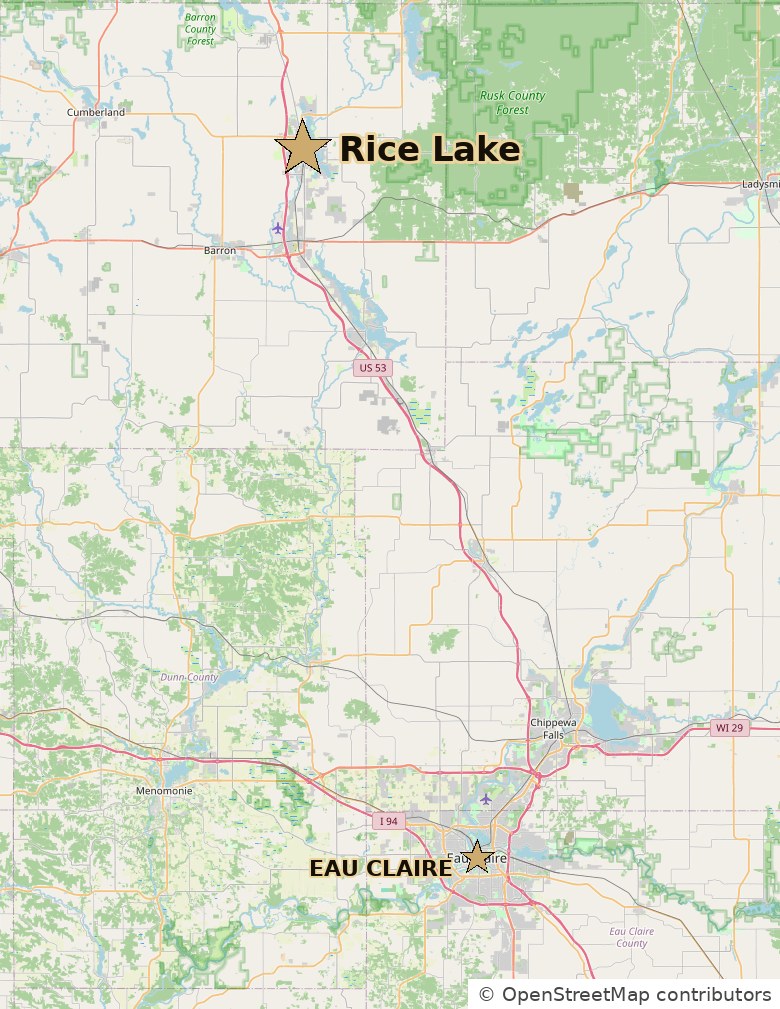
Both — and that is the whole point of the place. Rice Lake is the largest city in Barron County, about 55 minutes north of Eau Claire on US-53, and it sits on the east side of the lake it is named for, with homes and parks on the shore and the Red Cedar River running through it. It is a working hub first — hospital, campus and shopping — with the lake included, not a resort village built around one.
Think of it as two markets sharing one ZIP code. In-town homes stay within reach of local wages in a way pure resort towns do not, while lake frontage carries the vacation premium. That is why this guide does not quote a single number for the whole town — a median would mix two different markets together. Ask Carter for the current split, in-town against shoreline, before you set a budget.
Start with the water. Rice Lake is a river flowage, so ask about water-level fluctuation and the dock history at that address, and check the shoreline rules before you buy. Note which side of the lake the property sits on, because access, sun and services differ by shore. On rural and lake properties, pull the septic and well records rather than guessing at them.
The Rice Lake Area School District serves the city and a wide ring of surrounding towns, including Rice Lake High School and the Hilltop and Tainter elementary schools in town. The district covers a wide circle of lake and farm country, so confirm the assignment for any specific address with the district before you buy.
About 55 minutes north on US-53 in good conditions. Winter is the honest test: this guide calls US-53 a fair-weather friend, so if you plan to commute, time the run to Eau Claire in winter conditions and be honest about your tolerance before you fall for a house. That drive is part of the purchase, and it is better priced in before an offer than discovered after one.
Anyone who wants lake-country living with a hospital, a campus and a grocery store in the same town — full-timers first, cabin buyers second. It is also the front door to the northwest lake country, with Birchwood, Shell Lake and the Chetek Chain all day-trip close. If you want the shoreline to feel remote instead, the lakes east and west of town sit quieter, and that is a fair reason to look there.
About $329 a month on a $250,000 home. Rice Lake’s effective rate is $15.81 per $1,000 of full value on the 2025 levy; the schools are the biggest slice, and the city share runs higher than the smaller Barron County towns because Rice Lake is the county’s working hub. The Taxes & total cost section above breaks the whole bill down.
Call or text (715) 828-0039, or email Carter@echtrg.com — Carter can pull recent sold comps for any street in this guide and line up showings so you can compare in person.