Good fit if…
You want newer construction and subdivision living without giving up the Eau Claire metro — and you like having a lake and a growing dining district inside your own city limits.
 Carter Barstad
REALTOR®

A Chippewa Valley City Guide · River Prairie · Lake Altoona · Its Own School District
Newer homes. Ten minutes to everything.
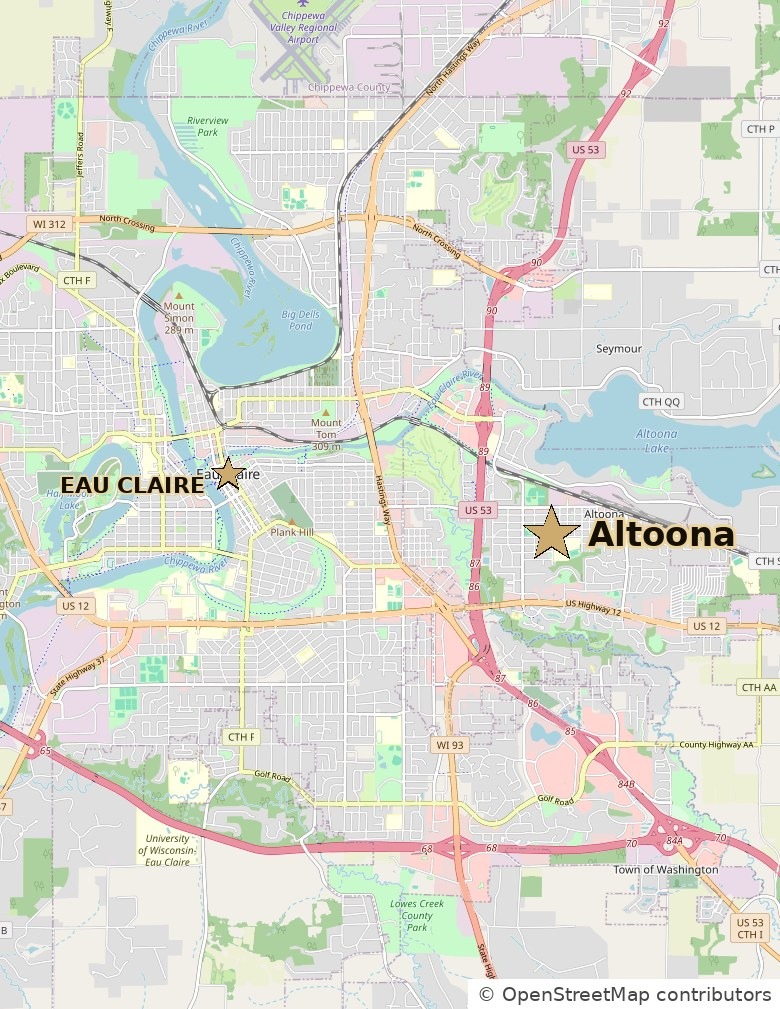
Distances and lake size as reported in the sources on the closing page; verify school assignment for a specific address. For the lake itself — fishery, drawdown, dock depth — see the companion Lake Altoona guide in this set.
“If Eau Claire is the big sister and Chippewa Falls the first, Altoona is the smaller sister city — and it’s really taken off since I was a kid. River Prairie and the newer residential developments changed the place. What you get is great schools — including a newer elementary — and quieter neighborhoods than you’ll find in Eau Claire, with everything Eau Claire offers right down the road.”
Carter Barstad · Hometown Realty Group
Altoona sits directly east of Eau Claire and functions as its closest neighboring city, with Lake Altoona — a reservoir on the Eau Claire River — at its east side. The lake has public access and anchors the city's outdoor identity.
The city has grown steadily as Eau Claire has grown, and much of its housing stock is newer than Eau Claire's in-town neighborhoods: subdivisions of single-family homes built from the 1990s onward, alongside older homes near the city's original core. River Prairie, the city's newer mixed-use district near the Eau Claire River, has added restaurants, a park and event space, and newer housing on the city's west side.
Subdivisions of single-family homes built from the 1990s onward dominate, with older homes near the original core and newer housing in and around River Prairie. Because so much of the stock is newer construction, the comparison work is different from Eau Claire's historic districts: age, lot size, HOA dues, and builder quality vary more than most buyers expect, and two homes at the same price can sit in very different long-term positions.
On a showing, that makes Altoona a comparison exercise more than a treasure hunt. Two homes at the same price can sit in very different long-term positions, so walk the lot as carefully as the kitchen: check the size, look at how the grading will handle a big rain, and read the HOA dues into the monthly number, not just the headline price. The older core and the River Prairie edge feel different again — same city, different trade-offs — which is exactly why Carter lines up showings across subdivisions instead of falling for the first new build.
Altoona has its own school district — one of its defining differences from Eau Claire addresses. A few streets near the line can fall on either side, so confirm the assignment for any specific address before you buy.
For many buyers, the district is the point: a city this close to Eau Claire that still runs its own schools gives families a different set of choices than an Eau Claire address does. Treat the district line as part of the property itself — it does not move when you do — and check it the same way you would check the lot lines, before the offer, not after.
You want newer construction and subdivision living without giving up the Eau Claire metro — and you like having a lake and a growing dining district inside your own city limits.
You want historic character or a walkable older neighborhood — that's Eau Claire's central districts. And compare total cost, not just price: HOA dues and builder quality move the real number here.
Drive the commute into Eau Claire at the time you would actually make it, walk River Prairie, and spend a few minutes at Lake Altoona. Then compare the same budget in Altoona against Eau Claire's east side so the trade-offs are concrete.
Want this guide as a PDF? The full Altoona guide — the same content, printable — is free. No form, no email required; it just opens.
Download the full Altoona guide (PDF)Sources: City of Altoona, Wisconsin — ci.altoona.wi.us · Altoona Area Chamber of Commerce. Eau Claire County Treasurer — 2025 Mill Rates (2025 levy) · Wisconsin Department of Revenue — 2025 Statement of Taxes, Eau Claire County · This guide is a starting point, not a statement about every property. Verify schools, taxes, zoning, shoreline rules, water and septic systems, rental rules, and other priorities for a specific address before you buy.
House-hunting this week? See this week’s open houses in Eau Claire — every brokerage’s open houses, in one place, no sign-up needed.
CARTER’S SALES HERE
Guides are opinions; closings are proof. 3 of Carter’s 55 career sales are in Altoona — $1,505,000 in closed volume from the MLS-verified record behind the numbers on the home page. Most recent first:
| Street | Sold price | Sold date |
|---|---|---|
| 604 Manor | $365,000 | Aug 28, 2026 |
| 7000 South Shore | $630,000 | Jun 26, 2026 |
| 7000 South Shore | $510,000 | Jan 30, 2023 |
The short version: About $318 a month on a $250,000 home — the school district is the biggest piece of the bill, and it still lands roughly $109 a month under the same value across the line in Eau Claire.
Property taxes here run on the 2025 levy — the bills Eau Claire County mailed in December 2025, payable in 2026. A home in the City of Altoona in the Altoona School District carried a net rate of $15.25 per $1,000 of assessed value (Eau Claire County Treasurer, 2025 Mill Rates). A mill is just $1 for every $1,000, so read that as about $15.25 a year for each $1,000 the assessor says your home is worth. The tax is figured on the assessor’s value, which is supposed to track market value but can sit above or below what a home actually sells for; the county puts Altoona’s 2025 assessment ratio at 0.9472, so assessed values here run close to market value.
Altoona files its levy split with the state each year. Across the city’s whole 2025 tax roll (Wisconsin Department of Revenue, 2025 Statement of Taxes), the apportioned levy split roughly like this:
The school district is the biggest single driver of an Altoona tax bill — which fits the city: the district is one of the main reasons buyers choose Altoona, and it is also the largest line they pay for.
Here is the math, step by step. This guide lists no citywide median price, so the example uses a round $250,000 and treats that price as the home’s assessed value, just to keep the math clean:
What that estimate leaves out: Wisconsin knocks two credits off after the bill is calculated, so the real check is smaller than the gross figure — the lottery and gaming credit ($186.34 for a primary home in the Altoona district in 2025) and the first dollar credit ($62.11) take roughly $248 off a qualifying home’s bill. Special charges and assessments are not in the rate; they ride on top of it, parcel by parcel. And your home’s actual assessment will differ from the example price.
Why here, and not Eau Claire? Run the same $250,000 of assessed value through Eau Claire’s 2025 rate of $20.47 and the bill comes to about $5,120 a year — roughly $109 more a month than Altoona’s $318. That gap is part of the total-cost comparison this guide keeps pointing at, alongside HOA dues in the subdivisions. On a $250,000 Altoona home, plan on about $318 a month for the tax line, inside the full monthly equation: mortgage payment, plus taxes, plus insurance.
See how all 28 areas compare: Chippewa Valley property taxes, side by side.
About ten minutes. US-53 and I-94 — the two commuter spines — put downtown Eau Claire roughly ten minutes away, and the rest of the metro within easy reach. Still, drive the commute at the time you would actually make it before you buy; that is the honest test of any address here.
Yes. Altoona runs its own school district, separate from Eau Claire’s — one of its defining differences — and Carter points to the schools, including a newer elementary, as part of the draw. A few streets near the city edges can fall on either side, so confirm the assignment for the specific address before you buy.
Mostly subdivisions of single-family homes built from the 1990s onward, with older homes near the city’s original core and newer housing in and around River Prairie. Because so much of the stock is newer, compare subdivision by subdivision: age, lot size, HOA dues, and builder quality vary more than most buyers expect.
Ask about flood history, insurance, and shoreline rules before you fall for the view. Lake Altoona is an 840-acre reservoir on the Eau Claire River at the city’s east side, with public access, boating, and fishing; the lake itself gets its own guide in this set, covering the fishery, drawdown, and dock depth.
Price the same budget both ways. In Altoona it buys newer construction and subdivision living, quieter neighborhoods, and a lake and a dining district inside your own city limits; in Eau Claire’s central districts it buys historic character and walkable older neighborhoods. Compare total cost, not just price — HOA dues and builder quality move the real number here.
About $318 a month on a $250,000 home. The City of Altoona’s net rate is $15.25 per $1,000 of assessed value on the 2025 levy, the school district is the biggest piece of the bill, and the same value across the line in Eau Claire runs roughly $109 a month more. The Taxes & total cost section above breaks the whole bill down.
Call or text (715) 828-0039, or email Carter@echtrg.com — Carter can pull recent sold comps for any street in this guide and line up showings so you can compare in person.