Good fit if…
You’re relocating and want the whole map before the street-by-street detail — or you’re deciding between sides of town and want schools, prices, and trade-offs in one honest pass.
 Carter Barstad
REALTOR®

The Citywide Guide · Start Here, Then Narrow Down
Two rivers. One hometown. Every neighborhood placed.
Prices: Realtor.com — Eau Claire market data, October 2026 (checked Oct 26, 2026); median listing $332,400 at $188/sq ft, 49 days on market. Population: 2020 census (about 176,000 in the wider metro). Schools: Eau Claire Area School District profile (NCES data), 2024–25. Neighborhood medians rest on small listing counts — orientation, not appraisal.
“Here’s how I sort the city for buyers: the north side is more house for the money, the south side runs higher-end, the Third Ward is the most desired central address, and Eastside Hill is its more affordable sister up the hill. Pick your side of the river first — schools, prices, and commutes follow from that.”
Carter Barstad · Hometown Realty Group
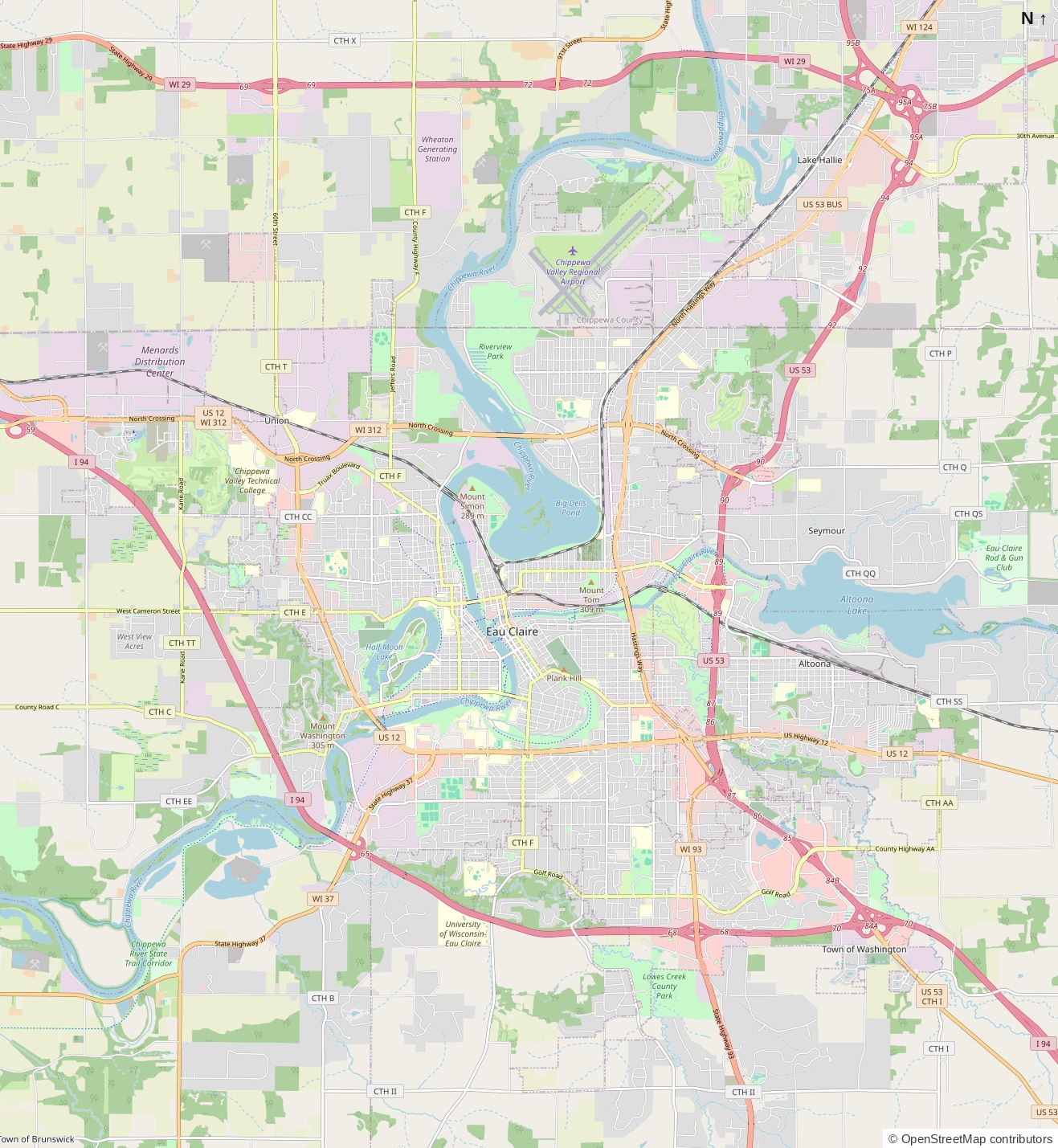
Downtown & the Confluence (center): Barstow Street’s shops and restaurants, Phoenix Park and the farmers market, the public library, and the Pablo Center — mostly condos, apartments, and smaller historic homes on the streets just off downtown, plus North River Fronts just north along the Chippewa. Just south: the Third Ward’s historic district (1870–1910 lumber-era homes) and UW–Eau Claire, with the Water Street district between them; Putnam Park and the Putnam Trail start here.
West of downtown, across the Chippewa: Randall Park wraps around its namesake park near Carson Park — the peninsula park in Half Moon Lake where Hank Aaron played in 1952 — and Owen Park; farther west, the West Side neighborhoods mix older streets near the river with mid-century and newer subdivisions. East, up the hill: Eastside Hill’s 1880s–1920s cottages and bungalows, Boyd Park, and the footbridge back downtown. North of the Eau Claire River: North Side Hill, the Airport neighborhood, Princeton Valley, Pinehurst, the Dells, and Sundet. South: Putnam Heights, London Road, Oakwood Hills, Memorial and Fairfax, out to Lowes Creek — the most suburban side, with Oakwood Mall retail and the Clairemont Avenue medical corridor.
Central neighborhoods (Downtown, Third Ward, Randall Park, Eastside Hill, North River Fronts) hold the city’s oldest stock — 1880s–1920s character homes with walkability to downtown, the university, and the trails. The South Side carries the widest range of newer construction and subdivision living. The North Side mixes established streets near the river with postwar and newer subdivisions farther out. The East Side posts the city’s most affordable entry by median listing price — and the widest mix of ages and conditions, so the exact block matters.
Nearly all of Eau Claire is in one district — the Eau Claire Area School District (ECASD), the eighth-largest in Wisconsin: about 200 square miles, about 10,687 students (2024–25), 12 elementary schools, 3 middle schools (DeLong, South, Northstar), and 2 high schools, plus charter options. The river rule: Memorial serves addresses south & east of the Chippewa and Eau Claire rivers; North serves addresses north & west. A few addresses near the Altoona line sit in the Altoona School District instead. Always confirm for a specific address at ecasd.us.
Citywide median listing price was $332,400 in October 2026, selling at about 100% of asking — a balanced market. Zillow’s typical home value ($317,833, Sep 2026) and Redfin’s median sale price ($314,850) land in the same ballpark. The area ladder, highest to lowest:
This guide carries the Chippewa Valley’s regional picture, so nothing is printed twice. The valley centers on Eau Claire and Altoona directly east — together they form the core of the metro. Chippewa Falls anchors the north, about fifteen minutes up Highway 53, with Lake Hallie between the two cities and Lake Wissota just northeast of the Falls. Smaller communities ring the core: Fall Creek to the southeast, Elk Mound and Menomonie to the west in Dunn County, and Cadott, Boyd, and Stanley to the northeast.
The pattern to understand: prices and lot sizes generally ease as you move out from Eau Claire’s core, while commute times grow. In-town Eau Claire offers the oldest housing stock and the shortest trips; Altoona is mostly 1990s-and-newer subdivisions plus the River Prairie district; Chippewa Falls mixes lumber-era character near the river with newer builds on the south side; the ring communities offer newer homes, bigger lots, and well-and-septic living in place of city services — compare total cost (taxes, utilities, services), not just price.
Schools are a patchwork beyond the city: ECASD in Eau Claire, Altoona’s own district, Chippewa Falls Area Unified (also serving most of Lake Hallie and Lake Wissota), and the smaller community districts in the ring towns. District lines don’t follow city limits everywhere — confirm the assignment for any specific address before you buy.
How to use the valley: pick two or three communities that fit your commute and budget, drive each one, and tour the same style of home in each — the differences in taxes, lots, and feel become obvious fast. Then narrow: one community, one deeper guide, one tour list. Every community and lake named here has its own guide in this set.
You’re relocating and want the whole map before the street-by-street detail — or you’re deciding between sides of town and want schools, prices, and trade-offs in one honest pass.
You already know your neighborhood. Go straight to its street-by-street guide — Third Ward, Randall Park, and Eastside Hill each have expanded editions — and use this one for the citywide numbers.
Start here, then go deeper: the expanded guides cover the Third Ward, Randall Park, and Eastside Hill street by street, with Altoona, Chippewa Falls, and the lake-country guides beyond. Carter can line up showings across two or three areas in one trip so you can compare them honestly.
House-hunting this week? See this week’s open houses in Eau Claire — every brokerage’s open houses, in one place, no sign-up needed.
Want this guide as a PDF? The full Eau Claire guide — the same content, printable — is free. No form, no email required; it just opens.
Download the full Eau Claire guide (PDF)Sources: Realtor.com — Eau Claire market data, Oct 2026 · ECASD profile (NCES data) · Volume One — school boundary changes · City of Eau Claire district discussions · Zillow ZHVI & Redfin, Sep 2026 · Visit Eau Claire · Eau Claire Area Chamber of Commerce. Prices are listing medians for the month shown, not appraisals, and they change monthly. Eau Claire County Treasurer — 2025 Mill Rates (2025 levy) · Wisconsin Department of Revenue — 2025 Statement of Taxes, Eau Claire County · This guide is a starting point, not a statement about every property. Verify schools, taxes, zoning, shoreline rules, water and septic systems, rental rules, and other priorities for a specific address before you buy.
Guides are opinions; closings are proof. 28 of Carter’s 55 career sales are in Eau Claire — $8,278,650 in closed volume across the city, from his MLS Agent Production & Inventory Report (the same record behind the numbers on the home page). Most recent first:
| Street | Sold price | Sold date |
|---|---|---|
| 3622 Damon | $265,000 | Aug 28, 2026 |
| Drier Road | $339,900 | Jul 1, 2026 |
| 1208 State | $315,000 | Jun 30, 2026 |
| 7th Street | $172,000 | Jun 25, 2026 |
| 1722 Mitchell | $310,000 | Jun 8, 2026 |
| 1720 South | $314,900 | Jun 8, 2026 |
| 2208 Menomonie | $475,000 | Feb 27, 2026 |
| 1433 Highland | $270,000 | Dec 9, 2025 |
| 2719 Ellis | $299,900 | Sep 22, 2025 |
| 1905 Skeels | $374,900 | Sep 15, 2025 |
| 1528 Bellevue | $210,000 | Jul 24, 2025 |
| 3403 Lever #B | $252,000 | Jul 14, 2025 |
| 209 Truman | $245,000 | Mar 31, 2025 |
| 3218 Glenhaven | $285,350 | Nov 22, 2024 |
| 435 Vine | $280,000 | Nov 20, 2024 |
| 524 MacArthur | $355,000 | Nov 15, 2024 |
| 1208 State | $260,000 | Sep 30, 2024 |
| 8435 Rambil | $330,000 | Sep 3, 2024 |
| 4408 Birch Hills | $525,000 | Aug 23, 2024 |
| 2818 7th | $247,000 | Aug 1, 2024 |
| 2719 Ellis | $280,000 | Jul 26, 2024 |
| 1009 Emery #1-2 | $255,000 | Mar 8, 2024 |
| 3952 Boardwalk | $160,000 | Dec 21, 2023 |
| 3415 Hallie | $148,900 | Oct 23, 2023 |
| County Highway W | $730,000 | Oct 3, 2023 |
| 1212 Folsom | $238,900 | Aug 31, 2023 |
| 1732 Coolidge | $184,900 | May 4, 2023 |
| 3410 Rudolph | $155,000 | May 2, 2023 |
The short version: About $567 a month on a median-priced Eau Claire home, with the city levy itself the biggest slice of the bill and the schools a close second. Where every dollar of it goes is broken down below.
Property taxes here run on the 2025 levy — the bills Eau Claire County mailed in December 2025, payable in 2026. A home in the City of Eau Claire in the Eau Claire Area School District carried a net rate of $20.47 per $1,000 of assessed value (Eau Claire County Treasurer, 2025 Mill Rates). A mill is just $1 for every $1,000, so read that as about $20.47 a year for each $1,000 the assessor says your home is worth. That last part matters: the tax is figured on the assessor’s value, which is supposed to track market value but can sit above or below what a home actually sells for. The county puts the city’s 2025 assessment ratio at 0.7645 — assessed values running at roughly three-quarters of market value — so a home’s tax value can sit well under its sale price.
Open a 2025 city tax bill and that $20.47 splits four ways:
There is no separate state line of any size on the 2025 bill — those four levies are the whole rate. The city levy is the biggest single driver of the bill, with the school district right behind it, so when either of those two budgets moves, your tax bill moves with it.
Here is the math, run step by step on this guide’s example price. The example treats the price as the home’s assessed value, just to keep the math clean:
What that estimate leaves out: Wisconsin then knocks two credits off after the bill is calculated, so the check you actually write is smaller than the gross figure above: the lottery and gaming credit ($194.74 for a primary home in the Eau Claire district in 2025) and the first dollar credit ($64.91) take roughly $260 off a qualifying home’s bill. Special charges and assessments are not in the rate at all — they ride on top of it, parcel by parcel. And your home’s actual assessment will differ from the example price, in either direction.
Why here, and not the next community over? The rate belongs to the city and the school district, not the neighborhood — what changes your bill inside Eau Claire is your assessment. Cross into Altoona and the structure changes with it: the same $332,400 of assessed value at Altoona’s 2025 net rate of $15.25 would bill about $5,070 a year instead, because Altoona runs a smaller city levy and its own school district. For a median-priced Eau Claire home, plan on roughly $567 a month for the tax line, and stack it where it belongs in the real monthly equation: mortgage payment, plus taxes, plus insurance.
See how all 28 areas compare: Chippewa Valley property taxes, side by side.
Eau Claire runs on a simple river rule: Memorial High School serves addresses south & east of the Chippewa and Eau Claire rivers, and North High School serves addresses north & west. A few addresses near the Altoona line sit in the Altoona School District instead. Always confirm the assignment for a specific address with the district at ecasd.us before you buy.
The citywide median listing price was $332,400 in October 2026 ($188/sq ft, a median 49 days on market), and homes were selling at about 100% of asking — a balanced market. By area, medians ran from the Third Ward at $384,900 down to West Riverside at $189,250. Zillow’s typical home value ($317,833, Sep 2026) and Redfin’s median sale price ($314,850) land in the same ballpark. Source: Realtor.com Eau Claire market data, Oct 2026.
In Carter’s words: the north side is more house for the money, while the south side runs higher-end. The numbers agree — East Eau Claire posts the lowest area median listing price at $249,400, and Eastside Hill ($283,000) is the more affordable sister to the Third Ward up the hill. The East Side also carries the widest mix of ages and conditions, so the exact block matters.
Nearly. Almost the whole city sits in the Eau Claire Area School District — the eighth-largest in Wisconsin, about 200 square miles with roughly 10,687 students (2024–25), 12 elementary schools, 3 middle schools (DeLong, South, Northstar), and 2 high schools, plus charter options. The exceptions are a few addresses near the Altoona line, which fall in the Altoona School District.
Most in-town drives are 10–15 minutes. Interstate 94 runs along the south edge of the city, US-53 is the north–south spine on the east side, and Chippewa Falls is about 15 minutes north. A trail system ties it together, too — you can walk or bike from Carson Park through downtown to the university along the rivers.
Central neighborhoods hold the city’s oldest stock — 1880s–1920s character homes — so check the big systems first: roof, wiring, plumbing, insulation, and foundation, and whether exterior work needs historic-district review. River and creek lots deserve a flood-map and insurance check, hill lots deserve a drainage look, and near UW–Eau Claire it’s worth noting whether the home and its neighbors are owner-occupied or rentals.
About $567 a month on a median-priced Eau Claire home ($332,400). The city’s net rate is $20.47 per $1,000 of assessed value on the 2025 levy, and the city levy itself is the biggest slice of the bill, with the schools a close second. The Taxes & total cost section above breaks the whole bill down.
Call or text (715) 828-0039, or email Carter@echtrg.com — Carter can pull recent sold comps for any street in this guide and line up showings so you can compare in person.