Good fit if…
You want the full northwoods destination: championship ski trails in February, musky water all summer, and lakes big enough to spend a lifetime learning — and you're buying a lake first, a property second.
 Carter Barstad
REALTOR®
An Expanded Lake-Country Guide · Sawyer County · Includes Lac Courte Oreilles · Chippewa Flowage 15,300 Acres · Lac Courte Oreilles 5,139 Acres · Platted 1883
Birkie country. Musky water. Big lakes.
Lake and town facts: Chippewa Flowage historical marker / HMdb and Wisconsin DNR (sources on the closing page). Facts checked October 2026.
Hayward is well past Ladysmith — Carter takes that kind of distance case by case, no lines drawn — and it belongs in this set for two reasons: the Birkie, and the history under it. Hayward was platted in 1883, when lumberman Anthony Judson Hayward dammed the Namekagon River and built the Big Mill; the mill burned in 1922, but the town it started became Sawyer County's seat and the capital of Wisconsin lake country.
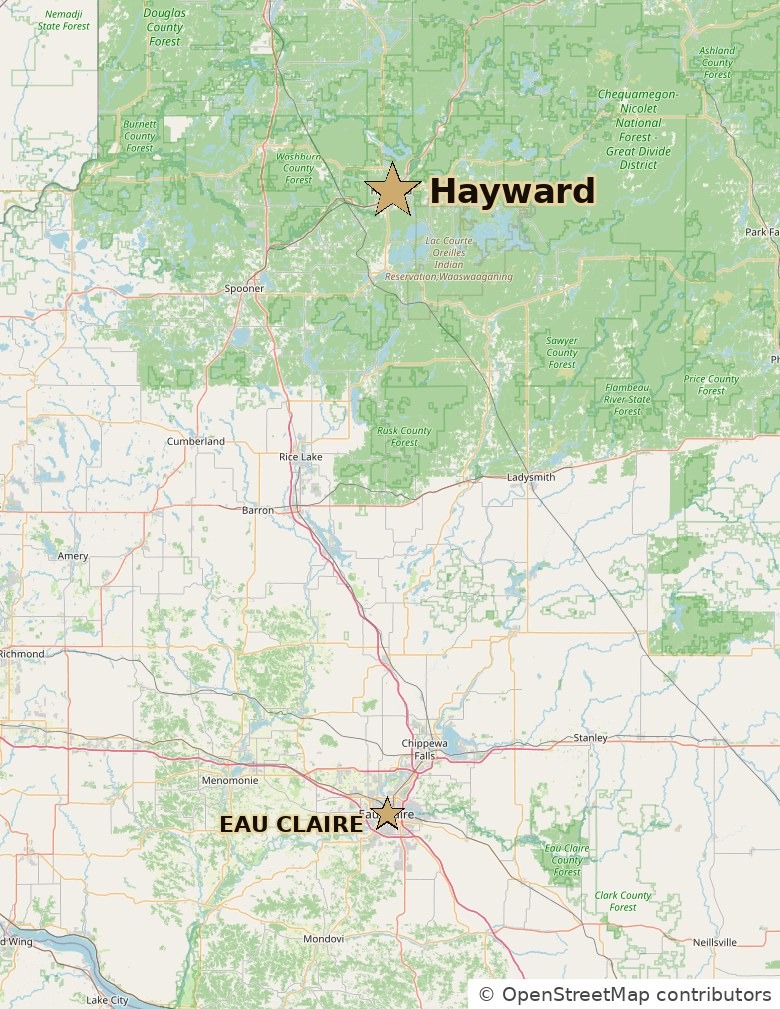
Hayward sits in Sawyer County on Highways 63 and 27, roughly two hours north of Eau Claire — a destination market, not a commute market. Buyers choose a lake first here, and a property second. Note that the flowage is homeland of the Lac Courte Oreilles Band of Ojibwe, whose Post village, burial grounds, and wild rice beds were flooded by its creation — history that deserves respect from anyone buying nearby.
The Chippewa Flowage — the “Big Chip” — is 15,300 acres of island-dotted musky water southeast of town, with wild rice beds, loons, and shoreline that stays wild and will never be heavily developed, so flowage homes trade on wilderness, not neighbors. Round Lake, to the east, is the clarity play: 3,294 acres of exceptionally clear water, about 74 feet deep.
Around both: the Birkie in February, the Lumberjack World Championships in summer, the Namekagon River — a National Scenic Riverway — for paddling and trout water, and the Chequamegon-Nicolet National Forest and Birkie Trail system for hiking, biking, skiing, ATV, and snowmobile seasons that rival the boating season.
Lac Courte Oreilles — “Lake of the Short Ears,” a French-era name for the Ottawa people — is the homeland water of the Lac Courte Oreilles Band of Lake Superior Chippewa. The reservation wraps much of the lake's western and southern country, and the lake's identity is inseparable from the Band's: this is a living tribal homeland with a resort economy built carefully alongside it.
The fishing fame is real and documented: Cal Johnson's 1949 musky — 67 pounds 8 ounces, 60½ inches — remains the all-tackle world record, and the mounted fish draws visitors to Hayward's Moccasin Bar to this day. Big LCO, Little LCO, Grindstone, and Whitefish together make a connected, musky-first chain: a thoroughfare connects LCO to 3,176-acre Grindstone Lake, and Round Lake's famous clarity is minutes away. Hayward is 15 minutes out — the Birkie, the Lumberjack Championships, and a full resort town serving your lake.
On the water: musky of record — plus walleye, both bass, northern pike, and panfish across 5,139 acres — and sandy swimming shoreline on the lake's famous sand flats and bays.
The market, honestly: LCO is trophy water and prices like it — per-front-foot math, bay by bay, with condition and land status moving numbers as much as square footage. This is Carter's case-by-case approach, worked deliberately: if LCO is your lake, he'll pull its recent sales and the Grindstone/Round comparables so the destination premium is priced with evidence, not folklore.
The spectrum is the widest in this guide set: classic knotty-pine cabins, family resorts that have anchored summers since the musky boom, and substantial lake homes on Round Lake and Lac Courte Oreilles. LCO's stock runs premier: established lake homes and estates on the big-water shores, classic cabins in the bays, and resort history along the east side. Inventory is relationship-driven; the best shorelines change hands quietly.
Hayward addresses are served by the Hayward Community School District, and the town provides a full grocery, hospital, and contractor base sized for a much larger summer population. Most LCO addresses are in the Hayward Community School District; the Lac Courte Oreilles Ojibwe School serves the tribal community. Confirm the assignment for any specific address with the district before you buy.
You want the full northwoods destination: championship ski trails in February, musky water all summer, and lakes big enough to spend a lifetime learning — and you're buying a lake first, a property second.
It's a destination, not a commute: two hours from Eau Claire. Near LCO, land status needs careful confirmation, and serious snow country means winter access is a first-order question, not a footnote.
Pick your lake first — Flowage wilderness, Round Lake clarity, or LCO's big water — then tour properties on that lake only. On LCO, pick your bay, and Carter will pull that bay's sales. Either way, recent sales lake by lake price the destination premium honestly.
Want this guide as a PDF? The full Hayward & the Big Lakes guide — the same content, printable — is free. No form, no email required; it just opens.
Download the full Hayward & the Big Lakes guide (PDF)Sources: Chippewa Flowage historical marker — HMdb · National Fresh Water Fishing Hall of Fame · Wisconsin DNR lake pages — Lac Courte Oreilles & Grindstone Lake · Lac Courte Oreilles watershed lake data (Big LCO 5,139 acres, ~90 ft) · International Game Fish Association — world-record musky, 1949 · Sawyer County · Wisconsin Department of Revenue, 2025 Town, Village and City Taxes (2025 levy, collected 2026) · Sawyer County Treasurer, Mill Rates. This guide is a starting point, not a statement about every property. Verify schools, taxes, zoning, shoreline rules, water and septic systems, rental rules, and other priorities for a specific address before you buy.
House-hunting this week? See this week’s open houses in Eau Claire — every brokerage’s open houses, in one place, no sign-up needed.
Start with the water, not the listing photos. A day on the Flowage feels nothing like a day on Round Lake, and neither feels like open water on Lac Courte Oreilles — the Flowage trades on wild shoreline and islands, Round Lake on clarity, and LCO on sheer size. Decide which of those you will actually use most, in ski season as well as boat season, and let that choice narrow the search before square footage enters the conversation.
Then tour deliberately. Compare properties inside one lake — and on LCO, inside one bay — so the differences you are seeing are the house and the lot, not three different lakes at once. Ask the unglamorous questions early: septic and well records, winter access and plowing, and how developed the shoreline around the lot is, and will stay. Carter works this market case by case, and deliberately: he will pull recent sales lake by lake, and bay by bay on LCO, so the destination premium is priced with evidence, not folklore.
The short version: In town, about $215 a month on a $250,000 home — one of the lighter city bills in this guide set, with the schools the biggest slice, and most lake property out in the towns runs lighter still.
In the City of Hayward, the 2025 levy (collected in 2026) works out to an effective rate of $10.32 per $1,000 of value, after the state school levy credit — the lightest of the northern communities in this guide series. A mill is simply $1 of tax for every $1,000 of value, and the rate is the whole stack of local levies added together. The tax is figured on the assessor’s value, not the sale price; Hayward assessments currently sit at about 99% of full market value, so here the value on the tax roll tracks the market closely — though an individual home’s assessment can still sit above or below what it would actually sell for.
Here is where the dollar goes, per $1,000 of full value, before the school levy credit:
That is a gross rate of $11.28; the state’s school levy credit trims $0.96, leaving the $10.32 effective rate. The school district is the biggest single driver, as it is in most Wisconsin communities, but every slice of the Hayward bill is comparatively light.
On a $250,000 home, treating that $250,000 as the value on the tax roll: Step 1 — $250,000 ÷ 1,000 = 250. Step 2 — 250 × $10.32 = $2,580 a year. Step 3 — that works out to about $215 a month.
That figure is the working number, not the final check. Wisconsin’s lottery and gaming credit (for a primary residence) and the first dollar credit are subtracted after the bill is calculated, so the amount actually due runs smaller. Special charges, and any lake-district or sanitary charges around the lakes, are not in the rate either. And a lake home’s assessment may differ from its price in either direction: on big-water frontage, assessments can run ahead of what a seasonal cabin would actually sell for, and behind a renovated year-round home.
The city rate above is the in-town figure. Most lake property — on the Flowage, Round Lake, Lac Courte Oreilles — sits in the surrounding towns, which carry no city levy; the Sawyer County Treasurer’s mill-rate sheets show town totals running below the city’s. The levy here is also spread across a deep lake-country tax base, much of it high-value shoreline. Budget the tax as a monthly line next to the mortgage and insurance: on the example above, roughly $215 a month is part of the real payment, every month, whether there is a loan on the place or not.
See how all 28 areas compare: Chippewa Valley property taxes, side by side.
They are different purchases. The Chippewa Flowage is 15,300 acres of island-dotted musky water with 233 miles of shoreline and about 200 islands, and its frontage trades on wilderness. Round Lake is the clarity play: 3,294 acres of exceptionally clear water, about 74 feet deep. Lac Courte Oreilles is the big water: 5,139 acres, about 90 feet deep. Pick your lake first, then tour properties on that lake only.
The American Birkebeiner is North America’s largest cross-country ski marathon, drawing more than 13,000 skiers each February. It finishes across Lake Hayward and down Main Street. Tony Wise founded it in 1973 with just 35 skiers, and it is a big part of why Hayward runs all winter, not just in boat season.
Land status, carefully. Tribal, allotted, and fee land mix near the lake and the reservation, so confirm status, jurisdiction, and any lease or shoreline agreements with professionals before you offer. On the lake’s open shores, also assess wind exposure and dock and shoreline erosion.
Hayward addresses are served by the Hayward Community School District, and most Lac Courte Oreilles addresses are in that district as well. The Lac Courte Oreilles Ojibwe School serves the tribal community. Always confirm the assignment for a specific address with the district before you buy.
Roughly two hours north, on Highways 63 and 27. That makes Hayward a destination market, not a commute market — and this is serious snow country, so winter access and plowing arrangements are a first-order question on any property here, not a footnote.
In town, about $215 a month on a $250,000 home — one of the lighter city bills in this guide set. Hayward’s effective rate is $10.32 per $1,000 of full value on the 2025 levy, the schools are the biggest slice, and most lake property out in the towns runs lighter still. The Taxes & total cost section above breaks the whole bill down.
Call or text (715) 828-0039, or email Carter@echtrg.com — Carter can pull recent sold comps for any street in this guide and line up showings so you can compare in person.