Good fit if…
You want lake living as part of everyday life — a dock behind the house, fishing after dinner, and a normal metro commute. No other lake in this guide set sits this close to Eau Claire.
 Carter Barstad
REALTOR®

An Expanded Lake Guide · Eau Claire County · 840 Acres · 9.9 Miles Of Shoreline · Ten Minutes From Downtown
A dock behind the house. Downtown down the road.
Lake facts: Wisconsin DNR Lake Altoona Fisheries Survey Report, 2025, and the Wisconsin DNR lake page for Lake Altoona (sources on the closing page). For the city around the lake — subdivisions, schools, River Prairie — see the companion Altoona guide in this set.
The lake was created in 1938, when the Altoona dam impounded the Eau Claire River for recreation and water conservation; Eau Claire County owns and operates the dam, and no power is generated. Lake Altoona County Park anchors the south shore with the county's main landing and beach area.
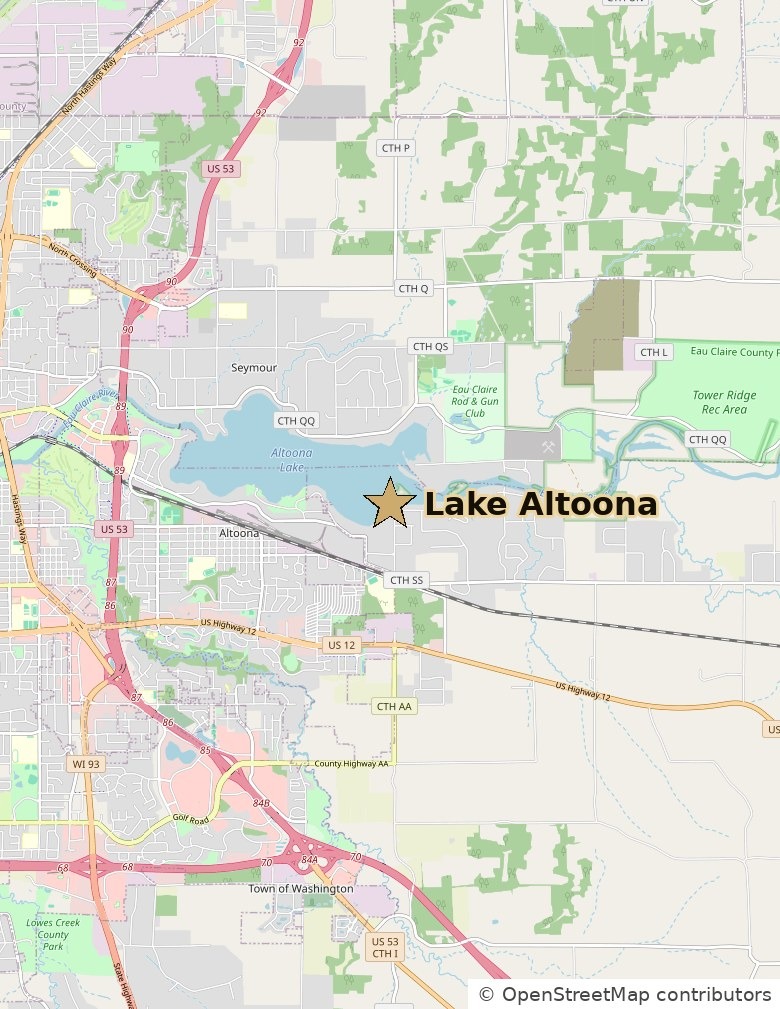
The lake sits at the east edge of the Eau Claire–Altoona metro. The west end near the dam is minutes from Eau Claire neighborhoods and the River Prairie district; the east end reaches up the Eau Claire River toward the quieter, shallower delta. Which end you buy on decides whether this feels like an in-town home with a dock or a river-cabin retreat.
Shoreline development is established and mostly year-round: a mix of older lake homes and cottages, updated and rebuilt homes on the deeper south and west shores, and quieter places up the river end. Because the lake is inside the metro, these are typically primary homes with docks, not remote cabins — you trade wilderness for a ten-minute run to groceries, schools, and work.
Shoreline addresses fall in the Altoona and Eau Claire Area school districts depending on the side of the lake — confirm the assignment for a specific address. City and county services are close at hand, though many lake homes still run on private septic; ask for system records either way.
You want lake living as part of everyday life — a dock behind the house, fishing after dinner, and a normal metro commute. No other lake in this guide set sits this close to Eau Claire.
Water conditions need understanding: the DNR classifies the lake as eutrophic, the river delivers an ongoing load of sand that periodically requires dredging, and a roughly two-foot winter drawdown limits ice damage — all manageable, all worth knowing before you buy a shallow east-end lot.
Tour one home on the deeper west/south shore and one up the river end, and check the water at the dock at both. Carter can tell you what recent lake sales actually closed for, street by street, so the convenience premium is priced honestly.
Want this guide as a PDF? The full Lake Altoona guide — the same content, printable — is free. No form, no email required; it just opens.
Download the full Lake Altoona guide (PDF)Sources: Wisconsin DNR — Lake Altoona Fisheries Survey Report, 2025 · Wisconsin DNR lake page — Lake Altoona. Eau Claire County Treasurer — 2025 Mill Rates (2025 levy) · Wisconsin Department of Revenue — 2025 Statement of Taxes, Eau Claire County · This guide is a starting point, not a statement about every property. Verify schools, taxes, zoning, shoreline rules, water and septic systems, rental rules, and other priorities for a specific address before you buy.
House-hunting this week? See this week’s open houses in Eau Claire — every brokerage’s open houses, in one place, no sign-up needed.
Most lake guides in this set describe a place you drive to. This one describes a place you live. Because the lake sits inside the metro, a home here is typically a primary home with a dock, not a remote cabin — the fishing can happen before or after work, the beach day can happen at Lake Altoona County Park on the south shore, and the run to groceries, schools, and work is about ten minutes. That changes what a showing should test: not just how the place feels on a Saturday, but how it fits an ordinary Tuesday.
It also pays to tour the lake’s two personalities side by side. The deeper west and south shores near the dam feel in-town; the quieter river-delta east end feels like a cabin retreat, with shallower water where sediment builds up. A single visit in a single season will not tell you the whole story of either shore — ask how the roughly two-foot winter drawdown affects that lot’s shoreline, dock, and lift setup, and ask about any lake-district assessments or dredging history attached to the property. Those answers, lot by lot, are where the honest comparison lives.
For sellers, the same logic runs in reverse: the convenience is the headline, and it should be priced with evidence. Carter can tell you what recent lake sales actually closed for, street by street, so the convenience premium is priced honestly — neither given away nor guessed at.
The short version: On the Altoona side, about $318 a month on a $250,000 home, with the school district the biggest piece of it. Shoreline parcels inside the lake district itself run higher — about $373 a month on the same value — because the lake work rides on top.
Lake Altoona has no single tax rate, and any guide that gives you one is guessing. The shoreline sits mainly in the City of Altoona, with lake parcels also in the surrounding towns, and each municipality levies its own rate. The primary rate to know is the city’s: for the 2025 levy — the bills Eau Claire County mailed in December 2025, payable in 2026 — a home in the City of Altoona in the Altoona School District carried a net rate of $15.25 per $1,000 of assessed value (Eau Claire County Treasurer, 2025 Mill Rates). A mill is just $1 for every $1,000, and the tax is figured on the assessor’s value, which is supposed to track market value but can sit above or below what a home actually sells for.
Where the dollar goes follows the jurisdiction the parcel sits in. Across the City of Altoona’s whole 2025 tax roll (Wisconsin Department of Revenue, 2025 Statement of Taxes), the apportioned levy split roughly like this:
Here is the math, step by step, on a round $250,000 example — this guide lists no median lake price, and the example treats the price as the home’s assessed value:
What that estimate leaves out: Wisconsin knocks two credits off after the bill is calculated — the lottery and gaming credit ($186.34 for a primary home in the Altoona district in 2025) and the first dollar credit ($62.11) — so a qualifying home’s real check is roughly $248 smaller than the gross figure. Special charges and any lake-district assessments are not in the rate; they ride on top of it, and the guide’s advice stands: ask about assessment and dredging history for the specific property. Town parcels run different math entirely — a $250,000 value in the Town of Washington in the Altoona district, at $11.08, bills about $2,770 a year — because a town levies for fewer services than a city does. Whichever shore you land on, put the tax line in the full monthly equation: mortgage payment, plus taxes, plus insurance — about $318 a month at the city rate on this example, before the credits come off.
See how all 28 areas compare: Chippewa Valley property taxes, side by side.
840 acres, with 9.9 miles of shoreline and a maximum depth of 25 feet. It is a reservoir on the Eau Claire River, created in 1938 when the Altoona dam impounded the river for recreation and water conservation; Eau Claire County owns and operates the dam, and no power is generated.
That depends on the life you want. The deeper west and south shores near the dam feel in-town, minutes from Eau Claire neighborhoods and the River Prairie district. The east end reaches up the Eau Claire River toward the quieter, shallower delta and feels like a river-cabin retreat. Tour one of each and compare, and check the water depth at the dock at both.
The lake is drawn down roughly two feet in winter, which limits ice damage. It also affects a given shoreline, dock, and lift setup differently from lot to lot — especially toward the east end — so ask how it plays out at the specific property, and ask about lake-district assessments and dredging history while you are at it.
Shoreline addresses fall in the Altoona and Eau Claire Area school districts depending on the side of the lake. Confirm the assignment for a specific address before you buy. Either way, city and county services are close at hand, though many lake homes still run on private septic — ask for system records.
The DNR’s 2025 fisheries survey describes a well-known panfish fishery, plus walleye, smallmouth and largemouth bass, northern pike, and musky. It is a home-water fishery the DNR surveys regularly — one you can use before or after work.
Yes. There are two public boat landings, and Lake Altoona County Park anchors the south shore with the county’s main landing and beach area — a beach day, a picnic, and a launch without owning frontage.
On the Altoona side, about $318 a month on a $250,000 home. The rate is the City of Altoona’s net $15.25 per $1,000 of assessed value on the 2025 levy, with the school district the biggest piece; shoreline parcels inside the lake district itself run higher — about $373 a month on the same value — because the lake work rides on top. The Taxes & total cost section above breaks the whole bill down.
Call or text (715) 828-0039, or email Carter@echtrg.com — Carter can pull recent sold comps for any street in this guide and line up showings so you can compare in person.